AI-supported simulation for nursing and health-professions education.

AvaNUR lets students practice realistic patient encounters with a lifelike AI patient and get structured, rubric-based feedback. Scenarios span motivational interviewing, de-escalation, telehealth, and specialty-specific training.

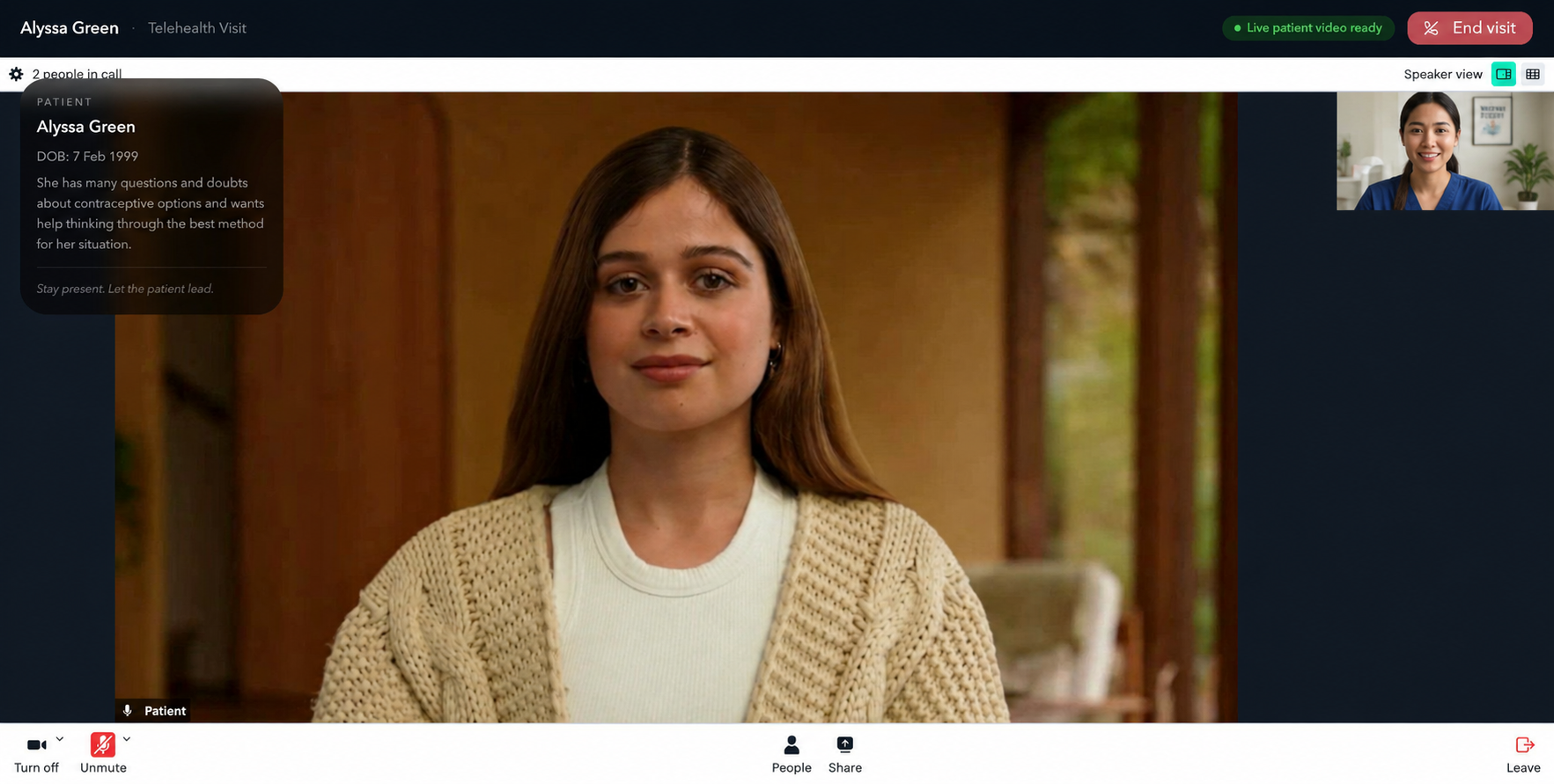
A nursing student in a live telehealth encounter with an AI patient named Alyssa Green.

How it works

Five steps. One platform.

01 / AUTHOR

Design the scenario.

Faculty author patient background, hidden context, disclosure rules, behavioral guardrails, and starting patient state.

02 / LAUNCH

Send a session code.

Preview the case, set the avatar, and launch. A short code goes to the learner.

03 / ENCOUNTER

Talk to the patient.

The learner joins a live audio-video conversation with a lifelike AI patient. Tone, pace, and question style matter.

04 / EVALUATE

Score the encounter.

An AI-assisted evaluation grades the visit against a rubric and surfaces concrete strengths and growth areas.

05 / DEBRIEF

Review with faculty.

Faculty review the full transcript, rubric, trajectory shifts, disclosure history, and add instructor notes.
The Encounter

A real-feeling conversation, not a chatbot.

Learners join a live audio-video session with an AI patient rendered by a photorealistic video avatar. The patient responds to tone, pace, and question style. They hold back the way real patients do, disclose when the learner earns it, and stay in character within scenario guardrails.

Learner Feedback

Structured feedback after every encounter.

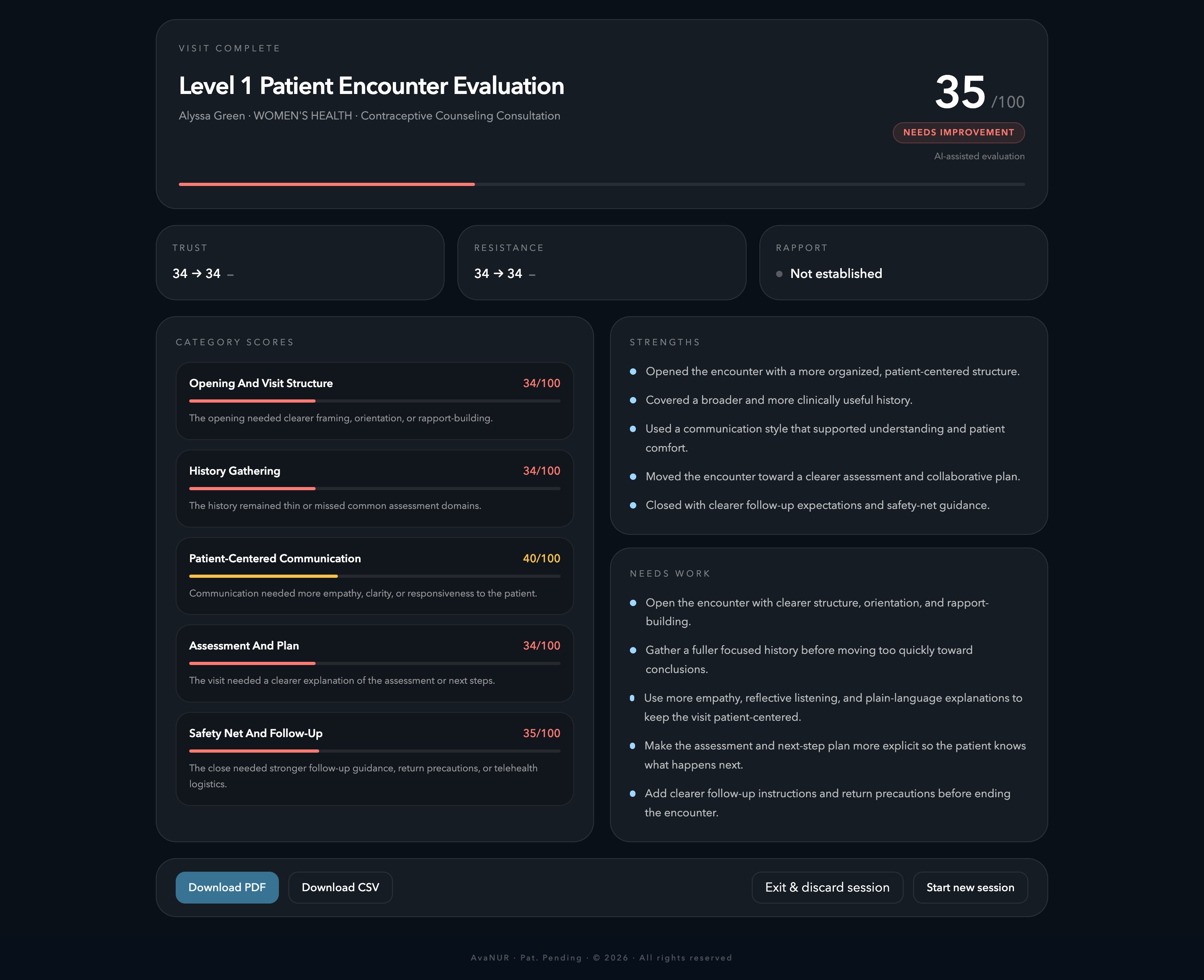
After the session ends, learners see an AI-assisted evaluation across five domains. Each domain comes with a score, a one-line explanation, and concrete strengths and growth areas. Downloadable as PDF or CSV.

  • Opening and visit structure
  • History gathering
  • Patient-centered communication
  • Assessment and plan
  • Safety net and follow-up
Student evaluation page with five category scores and strengths and needs-work lists.
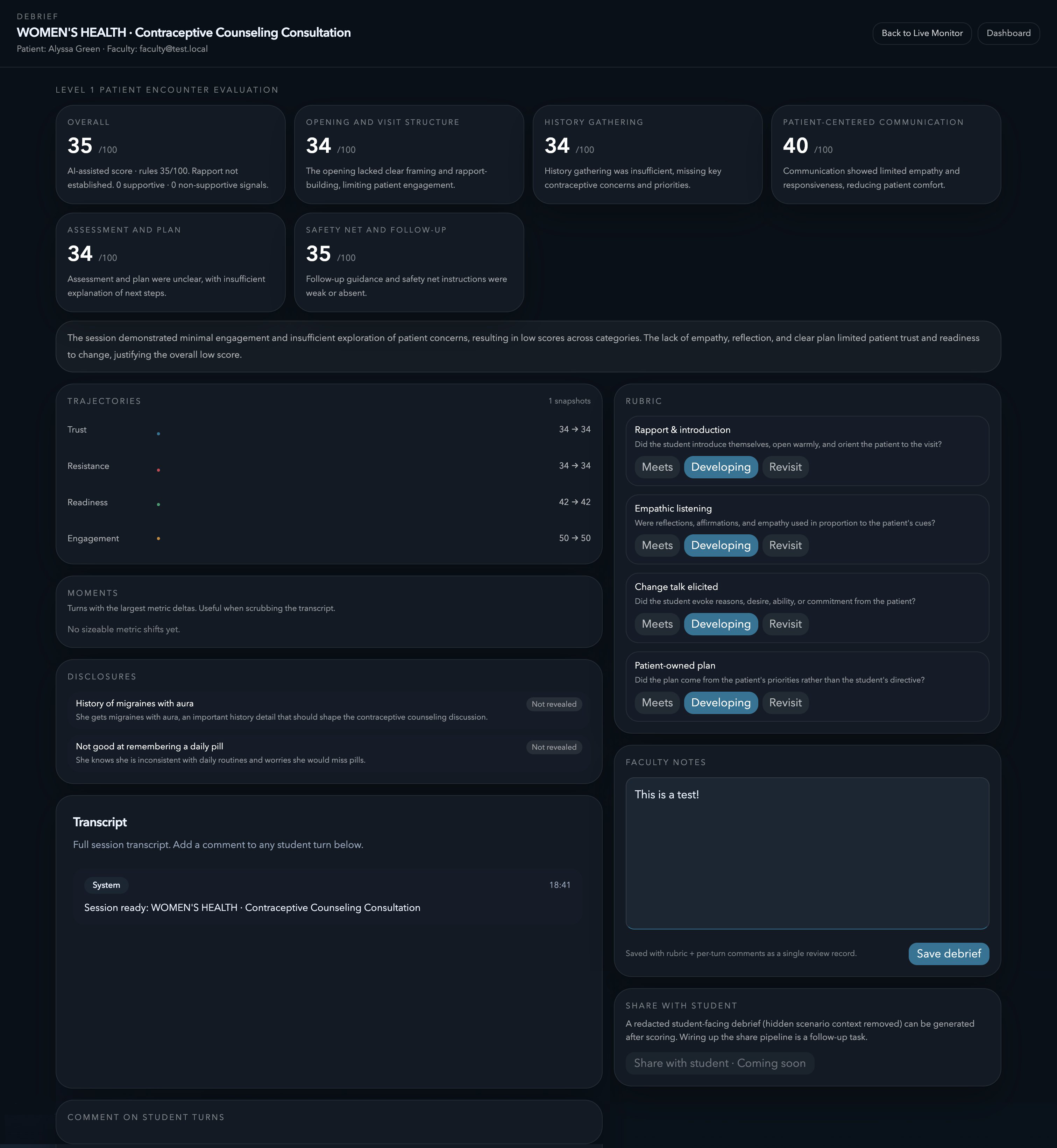
Faculty debrief view with rubric, trajectories, disclosures, transcript, and notes.

Faculty Debrief

Faculty stay in the loop.

Faculty get a parallel view with the full transcript, rubric-based scoring, patient-state trajectories, disclosure history, and a space for instructor notes. Debriefs save as a single review record and can be shared back to the student.

  • Trust, resistance, readiness, engagement trajectories
  • Per-turn rubric scoring with comments
  • Disclosure timeline
  • Single saved review record per session

Scenarios

A growing library.

AvaNUR ships with scenarios for motivational interviewing, NP-led encounters, de-escalation, women's health, and language-barrier practice. Faculty can also author custom cases in the built-in scenario builder.

Motivational Interview

Diabetes Medication Non-Adherence

Level 1 · 12–18 min
Motivational Interview

Smoking Cessation Ambivalence

Level 1 · 10–15 min
Motivational Interview

Diet and Lifestyle Change Resistance

Level 1 · 12–18 min
Motivational Interview

Alcohol Use Minimization

Level 1 · 12–18 min
NP Telehealth

Spanish-Language Fatigue Visit

Language barrier · 15–20 min
Women's Health

Contraceptive Counseling

Level 1 · 15–20 min
De-escalation

Dementia Medication Refusal

Level 1 · 10–15 min
De-escalation

ED Waiting Room Knee Pain

Level 1 · 10–15 min
Custom

Build your own scenario

Author in the scenario builder

Responsible AI

A coaching aid, not an autonomous evaluator.

Scenario guardrails constrain avatar responses to clinically appropriate ranges. Transcripts are reviewed for accuracy and bias. Faculty interpret all AI-generated feedback during debrief. AvaNUR is designed to supplement faculty-led simulation, standardized patients, and clinical learning, not replace them.

Sustainability

Climate-conscious simulation training.

Lower travel burden.

Remote, repeatable AI patient encounters reduce the need for students, faculty, and standardized patients to travel for every practice session.

Efficient digital practice.

Scenarios can be reused, revised, and shared digitally, limiting disposable materials, printed packets, and one-time-use simulation resources.

Scalable access.

Programs can offer more deliberate practice without proportionally increasing physical space, commuting, scheduling overhead, or material consumption.

AcknowledgmentsWith thanks to Dr. Bonnie Hepler; Dr. Ryan Shaw; Dr. Nikki Blodgett; and Kethia Dorceus Pierre, LCSWA.

Questions?

Let's talk.

For demos, collaborations, and faculty inquiries.

AvaNUR · Pat. Pending · © 2026 · All rights reserved